The patient
- Daily structure after formal PT ends
- Bigger movement, stronger voice, dual-task brain work — from a chair if needed
- Permission to walk again because Fall Guard is on
- A fatigue switch so an off day still counts
Crusade Continuum
Ongoing Parkinson's training after insurance PT ends, plus Fall Guard: the feature caregivers and patients have received with the most relief.
Open the appA person is diagnosed for life. Insurers typically pay for a short block of therapy — often around four weeks of programs like LSVT BIG and LOUD — then the visits stop. The patient is left with smaller movement, a quieter voice, and a home that suddenly feels like a trap. Caregivers carry a parallel weight: the fear that a walk down the block ends on the floor, with nobody knowing until it is too late.
The standout: Fall Guard
Families do not ask for another workout library. They ask: “What if they fall when I am at the store?” Fall Guard is the answer we built for that sentence.
Fall Guard is a wellness aid, not a medical device. It can miss a fall and it can false-alert. It does not replace 911. For families living with Parkinson's, it is still the difference between staying home “just in case” and living the next block of life.
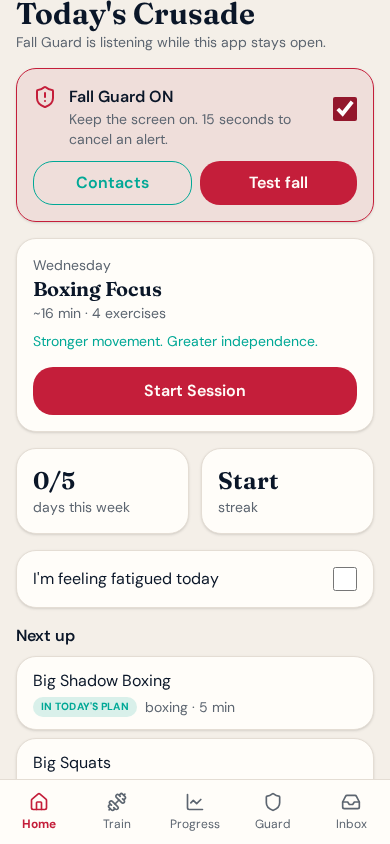
The day starts here. Patients see today's plan, a fatigue toggle for a gentler dose, and Fall Guard in one place. Caregivers glance at the crimson banner and know the walk is protected while the app stays open.
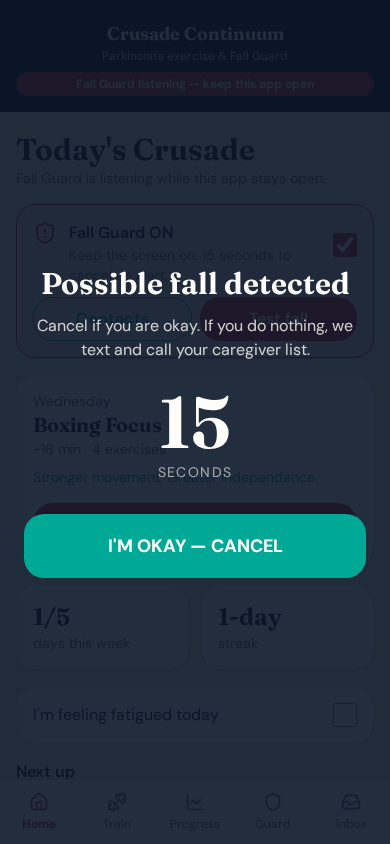
The feature families ask for by name. If a possible fall is detected, the screen takes over with a large countdown. Fifteen seconds to tap I'm okay. If nobody cancels, Crusade Continuum texts the caregiver list and opens a call. Independence with a safety net — not a locked-in life.
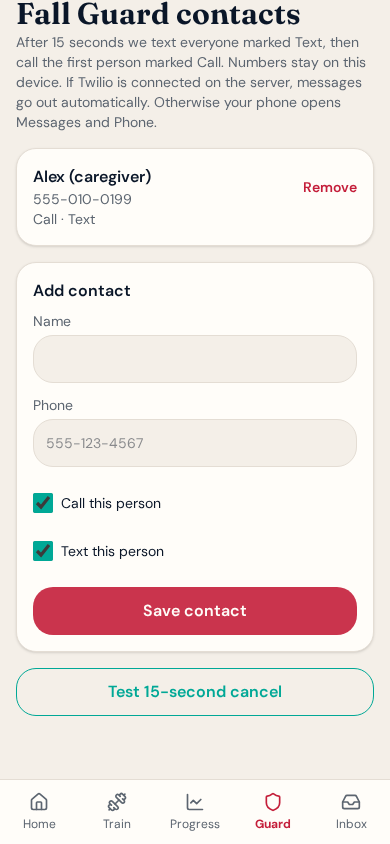
Add as many people as you need. Each contact can receive a text, a call, or both. Numbers stay on the device. When Twilio is connected, messages and calls go out automatically. Otherwise the phone opens Messages and Phone already filled in.
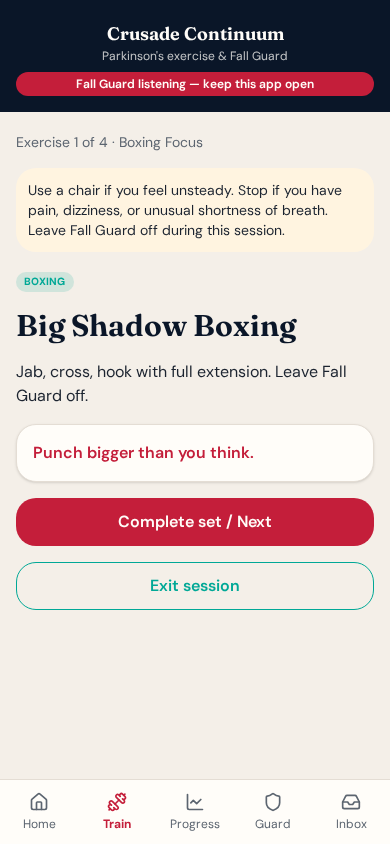
After insurance PT ends, most people are left with a paper packet. Continuum puts a daily session in their pocket: amplitude-focused movement, boxing, speech, dual-task work, and recovery — with a chair-first safety note on every screen.
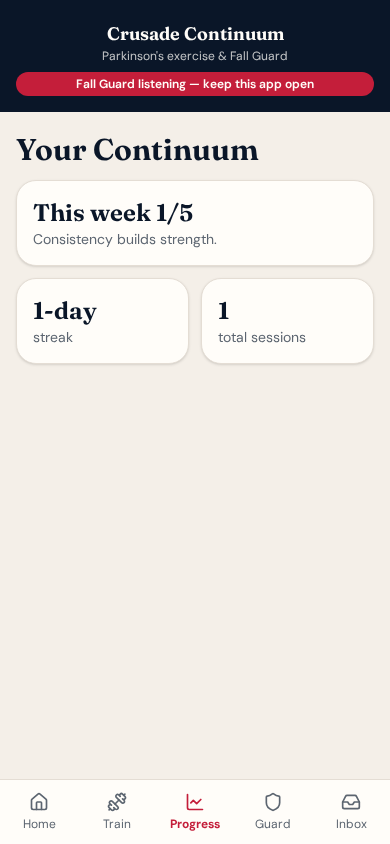
Parkinson's is a lifetime diagnosis. Streaks, weekly days, and total sessions give patients proof they showed up — and give caregivers a calm, factual picture instead of guessing from the hallway.
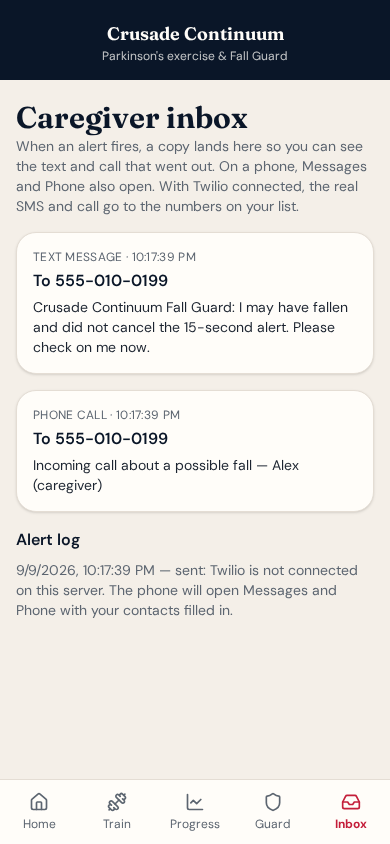
Every alert leaves a record: the text that went out and the call that was placed. Families can confirm the system fired. Patients can review a test before they ever take a walk around the block.
Patients keep training and keep walking. Caregivers keep their lives too — because if the floor comes up, someone is already being reached.
Back to Crusade Continuum